Samsung Galaxy S26 Ultra Review
Introduction
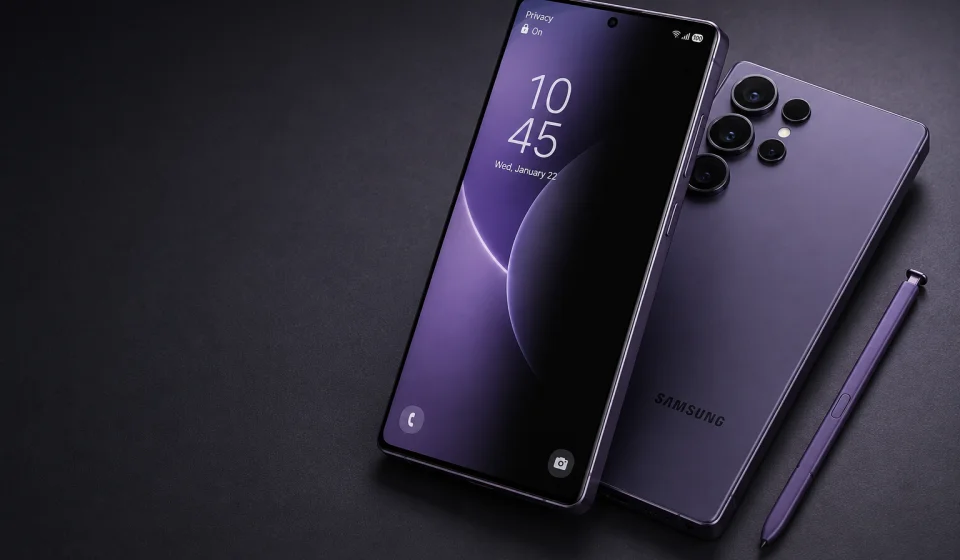
The Samsung Galaxy S26 Ultra is the top model in Samsung’s 2026 Galaxy S lineup, positioned above the Galaxy S26 and S26+. It is also the phone on which Samsung has concentrated nearly every headline feature: a built-in Privacy Display, an S Pen, a 200MP main camera, a customized Snapdragon processor, faster charging, and a deeper set of Galaxy AI tools. Samsung announced the Galaxy S26 series on February 25, 2026, and announced U.S. availability on March 10; exact retail dates vary by market.
In the United States, the unlocked Galaxy S26 Ultra starts at $1,299.99 for 256GB, rises to $1,499.99 for 512GB, and reaches $1,799.99 for 1TB. Those are flagship prices in the fullest sense of the word, even before accessories or a compatible fast charger. The phone is therefore competing not only with the iPhone 17 Pro Max and Google Pixel 10 Pro XL, but also with Android flagships that increasingly offer larger batteries, faster charging, and more ambitious camera hardware.
The S26 Ultra’s appeal is easy to understand. It is a large, exceptionally capable Android phone with an excellent screen, long software support, an integrated stylus, strong video tools, and enough performance for demanding apps and games. The harder question is whether Samsung has upgraded the areas that matter most to enthusiasts. Independent testing suggests a mixed answer: battery life and charging improve, but the camera system remains uneven, the frame is now aluminum rather than titanium, and sustained heavy workloads can trigger significant throttling.
Quick Verdict
Verdict
The Samsung Galaxy S26 Ultra is worth buying for buyers who want the most feature-packed Samsung phone and intend to keep it for years. Its best qualities are the versatile display, excellent main camera and video system, S Pen, reliable everyday performance, and seven generations of Android upgrades plus seven years of security updates.
Its weaknesses are more noticeable at this price. The 3x telephoto camera is the weakest of the four rear cameras, close-up photography is worse than on the Galaxy S25 Ultra, the 5,000mAh battery is merely adequate on paper for a phone this large, and prolonged CPU/GPU loads can produce heavy throttling.
The S26 Ultra is good value only if you will use its distinctive features—especially the S Pen, Privacy Display, Samsung’s productivity software, or long support commitment. If you mainly want the best still photography or the fastest charging and largest battery available, several Android alternatives deserve a closer look.
S26 Ultra specifications at a Glance
| Category | Details |
| Display | 6.9-inch Dynamic LTPO AMOLED 2X, 1440 × 3120 pixels, up to 120Hz, HDR10+, built-in Privacy Display |
| Processor | Qualcomm Snapdragon 8 Elite Gen 5 for Galaxy; Adreno 840 GPU |
| RAM | 12GB or 16GB, depending on storage |
| Storage | 256GB, 512GB, or 1TB; no microSD slot |
| Rear Cameras | 200MP wide, 50MP ultrawide, 10MP 3x telephoto, 50MP 5x telephoto/periscope-style module |
| Front Camera | 12MP autofocus camera |
| Battery | 5,000mAh |
| Charging | 60W wired, 25W wireless, 4.5W reverse wireless; Samsung claims up to 75% in around 30 minutes under its test conditions |
| Operating System | Android 16 with One UI 8.5 at launch |
| Connectivity | 5G, Wi-Fi, Bluetooth, NFC, USB-C, GPS, dual-SIM/eSIM support varies by market |
| Dimensions & Weight | 163.6 × 78.1 × 7.9mm; 214g |
| Protection | Gorilla Armor 2 front glass, Gorilla Glass Victus 2 rear, Armor Aluminum 2 frame, IP68 |
| U.S. Price | $1,299.99 (256GB), $1,499.99 (512GB), $1,799.99 (1TB) |
Regional configurations, colors, network bands, SIM arrangements, and promotional prices can differ.
Design and Build Quality
The Galaxy S26 Ultra is thinner and lighter than its predecessor, measuring 7.9mm thick and weighing 214g. That is a meaningful improvement for a phone with a 6.9-inch display, although it remains a large device. The wide body is comfortable for two-handed use and gives the S Pen room to live inside the chassis, but it is not an easy one-handed phone. Reaching the upper corners requires either shifting the phone in your hand or accepting a small risk of dropping an expensive rectangle.
Samsung uses glass on the front and back with an Armor Aluminum 2 frame. The front gets Gorilla Armor 2 and an anti-reflective coating, while the rear uses Gorilla Glass Victus 2. The change from the previous generation’s titanium frame is a curious one: Samsung argues that aluminum can absorb shock more effectively, but buyers may reasonably view it as a material downgrade in a premium phone. Competing Chinese flagships increasingly offer IP69 protection, whereas the S26 Ultra remains at IP68.
The redesigned camera island is visually cleaner than a collection of individually floating lenses, but it creates a practical annoyance. Because the lenses sit noticeably proud of the back, the phone wobbles when placed on a flat surface. A case solves that problem, but it also makes an already large phone larger. The rounded corners make the S26 Ultra look a little less like the sharply squared Galaxy Note descendants of recent years and a little more like the standard S26 models.
Button placement is familiar and easy to learn, and the S Pen remains accessible from the bottom edge. The overall build feels suitably dense and rigid. The important daily-use trade-off is that Samsung has made the phone slimmer without making it small: the S26 Ultra is easier to carry than the S25 Ultra, but it is still a device designed around a large display, a stylus, and a substantial camera system.
S26 Ultra Display
The 6.9-inch LTPO OLED panel is one of the S26 Ultra’s strongest components. It provides a sharp 1440 × 3120 resolution, adaptive refresh up to 120Hz, HDR10+ support, deep OLED contrast, and the smooth scrolling that makes Samsung’s interface feel polished. Text is crisp at the full QHD setting, while the high refresh rate makes scrolling through websites, social feeds, and long documents feel immediate.
Samsung ships the phone with a lower-resolution FHD setting enabled by default, according to Tom’s Guide’s hands-on report. That may conserve some power, but it is an odd choice on a phone whose screen is one of its central selling points. Users who care about maximum sharpness should check the display settings rather than assuming the panel is operating at its highest resolution.
The screen is also the first major smartphone display to integrate Samsung’s Privacy Display. It can restrict visibility for the entire screen, selected applications, incoming notifications, passwords, PINs, and patterns. In practical terms, that means a commuter can make sensitive content harder to read from the next seat without attaching a privacy screen protector that permanently reduces clarity.
The feature is useful, but its marketing suggests more secrecy than the hardware always delivers. The standard Privacy Display mode could still leave content roughly visible from an angle, while Maximum Privacy reduces contrast and color quality substantially. It also found that peak brightness was approximately halved with the privacy feature enabled. Tom’s Guide reported a similar limitation: a nearby passenger could still read much of a Slack conversation unless the reviewer held the phone closer than normal.
With Privacy Display turned off, S26 Ultra measured more than 700 nits in manual mode with Extra Brightness, 1,480 nits on a standardized 75% white patch in Auto mode, and more than 2,800 nits on a 10% test patch. The minimum measured brightness was 1.1 nits. These are independent lab results, not Samsung’s headline specification, and testing methods differ between publications.
The display is excellent for reading, video, photography, and games. It is also a particularly good fit for people who regularly use a phone in public spaces. However, the panel is not technically perfect: the lack of Dolby Vision certification, an 8-bit panel with frame-rate control rather than a native 10-bit panel, and the absence of high-frequency PWM dimming. None of those omissions ruins the everyday experience, but they matter to buyers comparing specifications at the top of the market.
Performance
The S26 Ultra uses an overclocked Snapdragon 8 Elite Gen 5 Mobile Platform for Galaxy, paired with an Adreno 840 GPU. Samsung positions it as the fastest processor in Galaxy history, while higher clock speeds on the customized chip compared with the standard version. The tested memory options are 12GB of RAM with 256GB or 512GB of storage, and 16GB of RAM with 1TB.
In ordinary use, this is more power than most people need. Apps open quickly, multitasking is effortless, image editing is comfortable, and demanding games have ample headroom. The practical benefit of the processor is less that messages open a fraction faster and more that the phone remains responsive while handling navigation, a camera session, large documents, split-screen applications, and background downloads at the same time.
Benchmark results put the S26 Ultra at or near the top of its comparison group, ahead of phones using the standard Snapdragon 8 Elite Gen 5, MediaTek’s Dimensity 9500, and Google’s Tensor G5 in the cited tests. Its Geekbench 6 scores were 3,781 single-core and 11,227 multi-core, while its AnTuTu v11 result was 2,627,986. These figures describe synthetic performance; they do not guarantee a proportionally faster everyday experience.
The more important caveat is sustained performance. Samsung redesigned the vapor chamber and enlarged the heat-transfer system, but found no meaningful improvement over the previous generation in extended CPU and GPU stress tests. It reported CPU performance falling below 50% of maximum and similar throttling in a 20-minute 3DMark Wild Life Extreme Stress Test.
That should not be confused with a phone that is slow. The S26 Ultra is extremely fast for short bursts and normal workloads. It simply is not immune to heat when pushed continuously. People who edit long 4K or 8K videos, play demanding games for extended periods, or run repeated computational tasks will notice the distinction more than people whose heaviest activity is switching between Chrome, WhatsApp, Spotify, and a camera app.
Gaming Performance
The S26 Ultra is a high-end gaming phone in capability, even though it is not built like a specialist gaming handset. The Snapdragon 8 Elite Gen 5 for Galaxy and Adreno 840 provide enough graphics power for demanding 3D games at high settings. Tom’s Guide reported that Destiny Rising ran well at maximum graphics at both 60fps and 120fps during a short hands-on session, although the phone became warm.
The 120Hz display and responsive touch layer make fast games feel smooth, while the large screen gives strategy, role-playing, and racing games more room to breathe. Samsung’s stereo speakers are also helpful when playing without headphones. The drawbacks are the same as those found in performance testing: long sessions can generate heat, sustained frame rates may fall as the phone throttles, and gaming is one of the fastest ways to turn a good battery day into an average one.
For casual and competitive players, the S26 Ultra should be more than sufficient. For buyers who play for hours at a time and care more about sustained frame rates than cameras, stylus support, or software features, a dedicated gaming phone may still be a better tool.
Camera System
The camera system is capable, versatile, and more complicated than the 200MP headline suggests. It includes a 200MP f/1.4 main camera with optical stabilization, a 50MP f/1.9 ultrawide, a 10MP 3x telephoto, a 50MP 5x telephoto, and a 12MP autofocus selfie camera. The main, ultrawide, and 5x cameras can record 8K video at 30fps; all cameras support up to 4K at 60fps, while the main and ultrawide cameras offer 4K at 120fps.
Main Camera
The 200MP sensor itself is not a clean-sheet upgrade. It is Samsung’s HP2 sensor, a component that dates back to the Galaxy S23 Ultra era. The more meaningful hardware change is the brighter f/1.4 lens, compared with f/1.7 on the S25 Ultra. That gives the camera more light-gathering potential and a slightly shallower depth of field with close subjects, but it does not transform the phone’s photography.
In daylight, the main camera is genuinely good, it has fine natural detail, well-controlled saturation, reliable white balance, and very good dynamic range. Skin tones are lively and slightly warm, and portrait mode applies blur conservatively enough to avoid the cut-out look that can make phone portraits appear artificial.
The 50MP shooting mode can preserve extra detail in good light, but the standard image processing is likely to be the better default for most people. At 2x, the main sensor produces usable results, though some textures are overly sharpened and processed. That is a reminder that a large pixel count does not automatically produce more natural photographs.
In low light, exposure, white balance, color, and dynamic range remain strong, but detail becomes softer, particularly in shadows. Samsung’s automatic Night mode behavior is also less flexible than before: the phone decides when the mode is available, and users cannot always force it on when they want a longer, brighter exposure. The results are generally good but not class-leading.
Ultrawide Camera
The 50MP ultrawide camera is dependable rather than exciting. In daylight, it delivers good detail, excellent dynamic range, and appealing colors. Its autofocus also gives it practical flexibility for subjects that are closer to the lens. At night, the camera can look soft and grainy in automatic mode, although stronger Night mode processing improves detail, clarity, and contrast.
The ultrawide is useful for architecture, landscapes, interiors, and group photographs, but it does not deliver the same fine texture as the best large-sensor competitors. The important point is that Samsung has produced a consistently usable ultrawide—not a camera that makes the phone a clear leader in this category.
Telephoto Cameras
The 3x telephoto is the weak link. It uses a 10MP sensor with optical stabilization, but its detail is somewhat sharpened and grainy in daylight, with softer and noisier results in low light. Color and dynamic range remain good, yet the camera does not feel as premium as the rest of the phone.
The 5x telephoto is better. Its 50MP sensor and brighter f/2.9 lens produce good daylight images with reliable white balance, wide dynamic range, and more pleasing portrait rendering. The revised optical design also gives out-of-focus highlights a more rounded appearance in some scenes. It is a useful long-range camera, but daytime results are not dramatically ahead of the S25 Ultra, and 10x and 30x zoom should be treated as convenient rather than magically detailed.
Close-up photography is a genuine regression. The main camera’s minimum focusing distance increased from 8cm on the S25 Ultra to 18cm on the S26 Ultra, while the 5x telephoto’s minimum distance doubled from 26cm to 52cm. The result is a phone that can photograph distant subjects well enough but struggles when you move close to flowers, food, documents, or small objects.
Front Camera
The 12MP autofocus selfie camera is one of the quieter successes in the system. It produces sharp images with wide dynamic range, vivid color, and surprisingly good low-light performance for a relatively small sensor. The new 23mm lens is wider than the S25 Ultra’s 25mm lens, so it fits more people and more background into the frame.
That makes the selfie camera useful for group shots and video calls, not just individual portraits. The megapixel count is modest, but the results show why sensor size, autofocus, optics, and processing matter more than a single resolution number.
Video
Video is arguably more impressive than still photography. The S26 Ultra records up to 8K30 on the main, ultrawide, and 5x cameras, and up to 4K120 on the main and ultrawide cameras. It also offers Pro video controls, 10-bit HDR, Log recording, Samsung’s APV codec, preloaded LUTs, and microphone-direction controls. The APV option is designed for high-quality recording but creates very large files, so external storage becomes sensible for serious work.
The main camera’s 4K footage is very good in daylight, with strong detail, color, dynamic range, and stabilization. The 3x telephoto remains softer than the other cameras, while the 5x and ultrawide cameras are more consistent. At night, exposure and color are good, but detail becomes softer and noisier, especially on the 3x camera.
Super Steady stabilization is available across the cameras, and Horizon Lock attempts to keep the image level while the phone rotates. The feature is interesting for action clips, although it is limited to 1440p. The practical verdict is simple: the S26 Ultra is a strong phone for creators who value recording flexibility and stabilization, even if its still-camera hardware no longer leads the Android field.
Battery Life and Charging
Samsung retains a 5,000mAh battery, a capacity that looks conservative beside the silicon-carbon cells appearing in some competing Android phones. The company claims up to 31 hours of video playback and up to 75% charge in around 30 minutes under its stated conditions. 60W wired charging, 25W wireless charging, and 4.5W reverse wireless charging.
Independent evidence is encouraging. A 16-hour-23-minute active-use score in its testing, while Android Authority described the S26 Ultra as one of the longest-lasting Android phones the reviewer had used. In one reported scenario, the phone retained almost 50% after 5 hours and 37 minutes of screen time, an overnight unplugged period, and a full day of use; the reviewer continued using it until 7 p.m. the following day.
Those numbers should not be treated as a universal promise. Battery life depends on network signal, display resolution, brightness, camera use, gaming, navigation, and background synchronization. The pattern is nevertheless clear: Samsung appears to have improved endurance through efficiency rather than by increasing battery capacity. A moderate user should be comfortable with a full day, and many light-to-moderate users may reach well into a second day. Heavy gamers, mobile-data users, and frequent camera users should plan around a charger.
Charging is finally less embarrassing for a flagship at this price. Android Authority reported 68% from 30% in less than 20 minutes in one test, while Tom’s Guide reached 50% in about 25 minutes with a charging setup that delivered a peak of 30W. The phone may require the correct charger and cable to approach its advertised 60W rate.
The S26 Ultra is not the fastest-charging phone in the world, but the combination of strong endurance and 60W wired charging is much easier to live with than Samsung’s older 45W ceiling. Wireless charging and reverse wireless charging add convenience for accessories, although neither replaces a fast wired charger when the battery is nearly empty.
Software and User Experience
The phone launches with Android 16 and One UI 8.5. Samsung’s interface remains feature-rich and highly configurable, with extensive controls for notifications, multitasking, themes, routines, edge panels, and the S Pen. That flexibility is useful for power users, although it also means the phone can feel busy until you disable or rearrange features you do not need.
Samsung’s support commitment is one of the strongest reasons to buy the S26 Ultra. The current Galaxy S policy promises seven major operating-system upgrades and seven years of security updates. That makes the phone a plausible long-term purchase rather than a device whose useful life depends on replacing it after two or three Android versions.
The trade-off is that Samsung’s software is broad rather than minimal. Buyers should expect Samsung and Google applications, duplicated services in some areas, and a considerable number of settings. The attached research sources do not establish a universal level of advertising or unwanted software across all regions, so this review does not make a blanket claim about ads. Pre-installed apps and carrier additions can vary by market.
The S Pen remains a precise tool for handwriting, annotation, drawing, document markup, and quick notes. However, the new S Pen reportedly loses Bluetooth functionality, which removes remote-shutter and other remote-control features available on older Ultra models. That is a meaningful downgrade for people who used the stylus as a camera remote, even though the core writing and drawing experience remains intact.
Privacy and security features benefit from Samsung’s long support policy, Knox platform, biometric authentication, and the hardware-assisted Privacy Display. The broader lesson is that the S26 Ultra’s software value is not just about new AI tricks: it is also about having a phone that should remain supported for most of the decade.
Audio and Connectivity
The Galaxy S26 Ultra uses stereo speakers and does not include a 3.5mm headphone jack. Testers measured speaker loudness at -25.9 LUFS and rated it very good in its test summary. The speakers should be well suited to podcasts, calls on speakerphone, games, and casual video, although wired-audio users will need USB-C headphones or an adapter.
Connectivity is appropriately flagship-grade, with 5G, modern Wi-Fi, Bluetooth, NFC, USB-C, GPS, and dual-SIM/eSIM options depending on the regional model. In daily use, that translates into fast network access, reliable navigation, tap-to-pay support, wireless Android Auto, and the ability to connect watches, earbuds, cars, and other accessories without unusual limitations. Exact bands and SIM combinations should be checked against the local Samsung specification page before purchase.
The USB-C port is particularly useful for the S26 Ultra’s creator features. High-resolution video, Log recording, APV files, and large photo libraries can consume storage quickly, so transferring files to a computer or external drive is more practical than relying solely on cloud storage.
Storage and Memory
Samsung offers 256GB, 512GB, and 1TB storage configurations. The 256GB and 512GB models come with 12GB of RAM, while the 1TB version includes 16GB. There is no microSD card slot. The storage is likely UFS 4.2 based on sequential write behavior, while noting that it could be UFS 4.1 and that the real-world difference is negligible.
The 256GB model is sufficient for messaging, streaming, office work, ordinary photography, and a sensible collection of games. The 512GB model is the better choice for people who record a lot of 4K or 8K video, keep large offline libraries, or intend to keep the phone for several years. The 1TB version is difficult to justify for most users unless the phone is also a primary video-production device; its 16GB of RAM is attractive, but the price premium is substantial.
Storage is therefore the one area where the cheapest model is not automatically the best value. A buyer who wants long-term headroom should consider 512GB, while a buyer who uses cloud storage and rarely records video can safely choose 256GB.
AI and Smart Features
Samsung’s Galaxy AI package is broader in the S26 Ultra than in previous generations, but its usefulness varies sharply by person, language, app, and region. The most practical way to evaluate it is feature by feature rather than treating the word “AI” as a guarantee of value.
Now Nudge monitors supported messages and suggests actions such as creating a calendar event or making a reservation. Samsung says processing occurs on the phone unless the user consents to share data for recommendations, but it also lists a limited set of supported messaging services. This can save steps when it works, though some users may reasonably dislike the idea of a phone analyzing the context of their conversations.
Now Brief surfaces reminders and contextual information from supported apps. It is potentially useful for people who want a daily summary, but it depends on having enough connected data and on trusting Samsung’s organization of personal information. Tom’s Guide also reported limitations in how Now Brief interacted with Privacy Display settings, so sensitive summaries may not always be hidden in the way users expect.
Bixby and Perplexity integration aim to make voice assistance more conversational and action-oriented. Bixby can interpret natural-language problems and point users toward relevant settings, while Perplexity can access apps and initiate multi-step workflows. The practical benefit is greatest for people who already use voice assistants; everyone else may find the conventional settings search faster.
Photo Assist lets users describe edits in natural language, including more complex changes. Some edits worked well, while others failed to switch elements successfully. This makes Photo Assist a useful creative shortcut, not a replacement for careful editing.
Creative Studio, screenshot search, Audio Eraser, and Document Scanner are more concrete tools. They can turn doodles into stickers, find information in screenshots, reduce background noise in supported media apps, and enhance documents for export as PDFs. These are the AI features most likely to produce repeatable value because they address specific tasks rather than simply generating a novelty image.
Availability is not universal. Tom’s Guide reported that automated Gemini app actions were not available in the United Kingdom during its hands-on testing. Some features require online services or supported apps, and their behavior can change through updates. Buyers should check Samsung’s regional feature list and language support before paying extra for AI capabilities.
S26 Ultra Price and Value
The U.S. unlocked launch price is $1,299.99 for 256GB, with 512GB and 1TB options at $1,499.99 and $1,799.99 respectively. Samsung’s direct store is also running promotional offers and trade-in incentives at the time of writing, but those discounts can change quickly and should not be confused with the phone’s normal retail price.
At full price, the S26 Ultra is not a bargain. Its value rests on the combination of features rather than on any single specification. The display is excellent, the processor is among the fastest available, the main camera and video system are strong, the S Pen is unique among mainstream flagship phones, and the update policy meaningfully lowers the cost of keeping the device for many years.
The value argument weakens if cameras are the main reason for buying. The 3x telephoto is underwhelming, close-up photography is worse than on the S25 Ultra, and independent testing suggests the overall camera system is not clearly ahead of last year’s phone. Buyers who already own the S25 Ultra should not upgrade simply because the S26 Ultra has a larger aperture or a newer AI menu.
The 512GB model is the most balanced configuration for long-term use, but it is expensive. The 256GB version makes more sense for most people if Samsung or a carrier offers a meaningful launch promotion. The 1TB model is a specialist purchase for heavy video users and storage maximizers.
Competition
The S26 Ultra does not have one universal competitor. Different phones win for different reasons, and a fair comparison depends on whether the buyer prioritizes cameras, charging, software, gaming, ecosystem, or the S Pen.
| Phone | Main Strength | Main Weakness | Best For |
| Samsung Galaxy S26 Ultra | S Pen, Privacy Display, long support, strong all-round feature set, excellent video tools | Expensive; uneven telephoto cameras; sustained-load throttling | Buyers who want the broadest Samsung experience and plan to keep the phone for years |
| Samsung Galaxy S25 Ultra | Similar overall experience, strong cameras, likely lower street price, better close-up behavior | Slower charging and no built-in Privacy Display | Existing Samsung users who want flagship quality without paying for modest generational changes |
| Xiaomi 17 Ultra | Stronger camera and battery performance | Software, availability, and ecosystem fit may be less attractive depending on market | Camera-first buyers who are comfortable outside Samsung’s ecosystem |
| Google Pixel 10 Pro XL | Google software and computational-photography approach | Lower benchmark performance than the S26 Ultra; no S Pen | Buyers who prefer Google’s software and photography style |
| Apple iPhone 17 Pro Max | Strong premium ecosystem and a serious alternative for video and long-term platform support | No S Pen and less Android-style customization | Apple users who value continuity with iOS, Macs, and Apple services |
The S26 Ultra outperforms the Pixel 10 Pro XL in chipset performance and battery endurance, while also offering faster charging and a more feature-rich display. The same review says Xiaomi’s 17 Ultra outperforms the S26 Ultra in key areas including camera and battery life, and that the S25 Ultra remains a sensible choice because the S26 generation’s upgrades are modest.
The takeaway is not that the S26 Ultra loses. Samsung’s advantage is breadth. It is the better choice for someone who wants a stylus, privacy hardware, mature multitasking, long support, and a wide video toolkit in one phone. It is not automatically the best option for a buyer who cares only about still photos, battery capacity, or charging speed.
S26 Ultra Pros and Cons
Pros
- Excellent 6.9-inch QHD LTPO OLED display with adaptive 120Hz refresh.
- Useful built-in Privacy Display that can target selected content.
- Strong main camera, autofocus selfie camera, and very capable video system.
- Snapdragon 8 Elite Gen 5 for Galaxy delivers top-tier short-burst performance.
- S Pen remains genuinely useful for notes, drawing, annotation, and productivity.
- Good endurance in independent testing and much faster 60W wired charging than previous Samsung Ultras.
- Seven Android upgrades and seven years of security updates support long-term ownership.
Cons
- The 3x telephoto camera is noticeably weaker than the main and 5x cameras.
- Close-up photography is worse than on the Galaxy S25 Ultra.
- Heavy sustained CPU and GPU workloads can cause significant throttling.
- The aluminum frame feels less premium than the previous generation’s titanium frame to some buyers.
- Privacy Display is not completely opaque at ordinary side angles and reduces brightness when enabled.
- No microSD card slot or 3.5mm headphone jack.
- High storage prices, particularly for the 1TB model.
Who Should Buy S26 Ultra?
Buy it if you:
- Want Samsung’s most complete flagship with an integrated S Pen.
- Regularly read, work, watch video, or edit photos on a large high-resolution display.
- Need long software support and expect to keep a phone for five years or more.
- Take a mixture of ordinary photos, portraits, landscapes, zoom shots, and stabilized video.
- Want strong gaming performance but do not need a dedicated gaming-phone design.
- Work or commute in public spaces and see genuine value in hardware-assisted screen privacy.
- Prefer Samsung’s customization, multitasking tools, and accessory ecosystem.
Avoid it if you:
- Mainly want the strongest still-camera system available, especially for telephoto or macro photography.
- Already own a Galaxy S25 Ultra and do not need faster charging or Privacy Display.
- Want the largest possible battery or the fastest charging in the Android market.
- Need microSD expansion or a headphone jack.
- Play demanding games for hours and care more about sustained frame rates than all-round features.
- Want a compact phone that is comfortable to operate with one hand.
Final Verdict
The Samsung Galaxy S26 Ultra is a very good flagship, but it is not a dramatic generational leap. Samsung has improved the ownership experience in meaningful ways: charging is finally competitive enough, endurance is strong in independent testing, the Privacy Display solves a real problem for some users, and the S Pen still gives the Ultra range that most rivals cannot match.
The biggest issue is that the camera hardware does not fully match the ambition of the rest of the phone. The main camera is excellent, the selfie camera is better than its numbers suggest, and video recording is highly capable. But the 3x telephoto, close-up limitations, and modest overall image-quality gains make the S26 Ultra less convincing as an uncompromising camera flagship. Sustained-load throttling and the switch from titanium to aluminum further complicate the idea that every part of the phone has been upgraded.
So, is the Samsung Galaxy S26 Ultra worth buying? Yes—if you want the most complete Samsung phone, will use the S Pen or Privacy Display, and value a long support window. It is also a sensible choice for buyers who want one device for work, entertainment, photography, gaming, and note-taking. If you already own the S25 Ultra, however, waiting for a discount or the next generation is more rational unless faster charging, privacy hardware, or improved battery efficiency directly solves a problem you have today.
At full price, the S26 Ultra is justified by its breadth rather than by unbeatable camera hardware. Buyers who prioritize still photography, extreme charging speeds, the biggest battery, or sustained gaming should compare alternatives before purchasing. For everyone else, it remains one of the most capable and future-proof Android phones of 2026.