
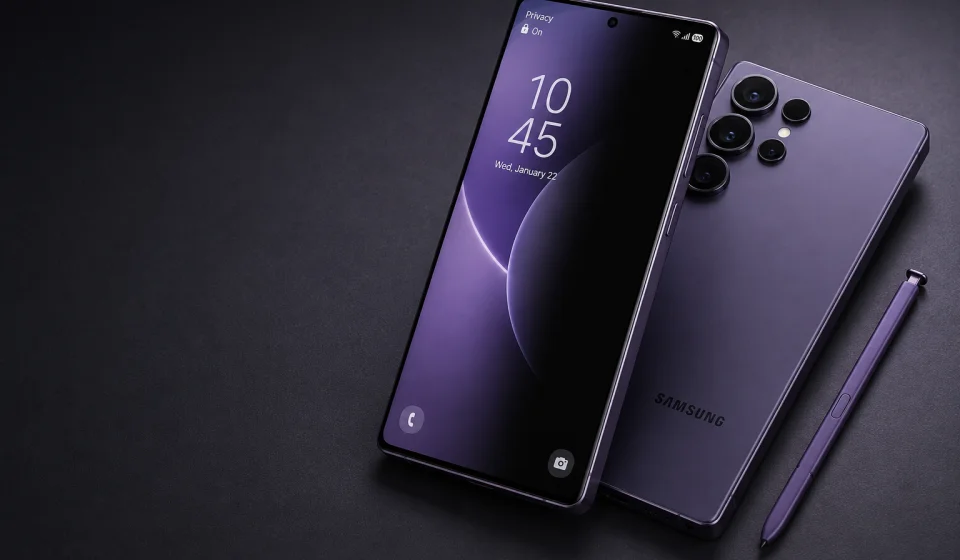
Samsung Galaxy S26 Ultra Review
Samsung Galaxy S26 Ultra Review: A Powerful Ultra With One Big Catch
The Samsung Galaxy S26 Ultra is the flagship model of the 2026 Galaxy S series, positioned above the Galaxy S26 and S26+. It incorporates nearly all of Samsung’s key features: an integrated privacy screen, an S Pen, a 200-megapixel main camera, a custom Snapdragon processor, faster charging, and a more comprehensive suite of Galaxy AI tools. Samsung announced the Galaxy S26 series on February 25, 2026, and its availability in the United States on March 10; exact release dates vary by market.
In the United States, the unlocked Galaxy S26 Ultra starts at $1,299.99 for 256GB, $1,499.99 for 512GB, and $1,799.99 for 1TB. These are prices befitting a high-end model, even without accessories or a compatible fast charger. The phone therefore finds itself competing not only with the iPhone 17 Pro Max and the Google Pixel 10 Pro XL , but also with flagship Android phones that offer ever-improving battery life, faster charging, and more advanced camera hardware.
The appeal of the S26 Ultra is undeniable. It’s a large Android smartphone with exceptional performance, boasting a superb display, long software support, an integrated stylus, powerful video tools, and enough processing power for even the most demanding apps and games. The more complex question is whether Samsung has truly improved the aspects most important to enthusiasts. Independent testing paints a mixed picture: battery life and charging speed are improved, but the camera system remains inconsistent, the chassis is now aluminum instead of titanium, and intensive, prolonged use can lead to a significant performance bottleneck.
Quick verdict
Verdict
The Samsung Galaxy S26 Ultra is an excellent choice for those looking for the most complete Samsung smartphone and who want to keep it for many years. Its key strengths include a versatile screen, an exceptional main camera and video system, the S Pen, rock-solid reliability for everyday use, and seven generations of Android updates, not to mention seven years of security updates.
Its weaknesses are more glaring at this price point. The 3x telephoto lens is the weakest of the four rear sensors, close-up photography is inferior to that of the Galaxy S25 Ultra, the 5,000 mAh battery is barely sufficient on paper for a phone of this size, and prolonged use of the processor and graphics card can lead to a significant reduction in performance.
The S26 Ultra offers good value only if you plan to use its exclusive features, including the S Pen, privacy screen, Samsung productivity software, and long-term technical support. If your primary focus is the best photo quality or the fastest charging and longest battery life on the market, several Android alternatives are worth considering.
Overview of the S26 Ultra’s features
| Category | Details |
| Display | 6.9-inch Dynamic LTPO AMOLED 2X display, 1440 × 3120 pixels, up to 120 Hz, HDR10+, with integrated privacy function |
| Processor | Qualcomm Snapdragon 8 Elite Gen 5 processor for Galaxy; Adreno 840 GPU |
| RAM | 12 GB or 16 GB, depending on the storage capacity. |
| Storage | 256GB, 512GB or 1TB; no microSD card slot |
| Rear cameras | 200 MP wide-angle lens, 50 MP ultra-wide-angle lens, 10 MP 3x telephoto lens, 50 MP 5x telephoto/periscope lens |
| Front camera | 12 MP autofocus camera |
| Battery | 5000 mAh |
| Charging | Charging power: 60W in wired mode, 25W in wireless mode, 4.5W in reverse wireless mode; Samsung advertises a charge of up to 75% in approximately 30 minutes under its test conditions. |
| Operating system | Android 16 with One UI 8.5 at launch |
| Connectivity | 5G, Wi-Fi, Bluetooth, NFC, USB-C, GPS and dual SIM/eSIM compatibility varies by market. |
| Dimensions and weight | 163.6 × 78.1 × 7.9mm; 214g |
| Protection | Gorilla Glass Armor 2 front glass, Gorilla Glass Victus 2 back glass, Armor Aluminum 2 aluminum frame, IP68 |
| American price | $1,299.99 (256 GB), $1,499.99 (512 GB), $1,799.99 (1 TB) |
Regional configurations, colors, network frequency bands, SIM card configurations and promotional prices may vary.
Quality of design and construction
The Galaxy S26 Ultra is thinner and lighter than its predecessor, measuring 7.9 mm thick and weighing 214 g. This is a significant improvement for a phone with a 6.9-inch screen, even if it remains a sizable device. Its wide form factor offers a comfortable two-handed grip and allows the S Pen to fit perfectly into the chassis, but it’s not easy to use with one hand. To reach the top corners, you either have to shift the phone in your hand or accept the slight risk of dropping this precious rectangle.
Samsung uses glass on both the front and back, with an Armor Aluminum 2 frame. The front features Gorilla Glass Armor 2 and an anti-reflective coating, while the back is protected by Gorilla Glass Victus 2. This change from the previous generation’s titanium frame is surprising: Samsung claims that aluminum absorbs shocks better, but buyers might legitimately consider it a step backward in terms of materials for a premium phone. While competing Chinese smartphones are increasingly offering IP69-certified models, the S26 Ultra remains IP68-certified.
The redesigned camera module is visually cleaner than a set of individual lenses, but it has a practical drawback: because the lenses protrude significantly, the phone is unstable when placed flat. A case solves this problem, but it further increases the bulk of an already large phone. The rounded corners give the S26 Ultra a less angular look, less like the Galaxy Note models of recent years, and closer to the standard S26 models.
The button placement is intuitive and easy to use, and the S Pen remains accessible from the bottom edge. Overall, the build quality is satisfactory, with a feeling of robustness and solidity. The main compromise for everyday use lies in the fact that Samsung has slimmed down the phone without making it smaller: the S26 Ultra is easier to carry than the S25 Ultra, but it remains a device designed around a large screen, a stylus, and a high-performance camera system.
S26 Ultra Display
The 6.9-inch LTPO OLED display is one of the S26 Ultra’s major strengths. It offers a crisp 1440 x 3120 pixel resolution, an adaptive refresh rate of up to 120 Hz, HDR10+ compatibility, deep OLED contrast, and smooth scrolling that gives the Samsung interface a polished look. Text is exceptionally sharp in QHD resolution, while the high refresh rate ensures seamless navigation on websites, social media feeds, and long documents.
According to Tom’s Guide’s review, Samsung ships the phone with a lower-resolution FHD setting enabled by default. While this might save power, it’s a strange choice for a phone whose screen is one of its main selling points. Users concerned with optimal sharpness should check the display settings rather than assuming the screen is operating at its maximum resolution.
This screen is also the first large smartphone display to incorporate Samsung’s Privacy Display technology. This technology allows users to restrict the visibility of the entire screen, specific apps, incoming notifications, passwords, PIN codes, and lock patterns. In practical terms, this means that a public transport user can make sensitive information harder to read from the seat next to them without having to install a screen protector that permanently impairs clarity.
This feature is useful, but its marketing suggests greater privacy than the hardware actually offers. In standard “Privacy Display” mode, content remains partially visible from a certain angle, while in “Maximum Privacy” mode, contrast and color quality are significantly reduced. The test also revealed that maximum brightness was roughly halved when the privacy feature was enabled. Tom’s Guide reported a similar limitation: a nearby passenger could still read a large portion of a Slack conversation unless the tester held their phone closer than usual.
With Privacy Mode disabled, the S26 Ultra measured a brightness of over 700 nits in manual mode with the Increased Brightness option, 1,480 nits on a standardized white test pattern at 75% in automatic mode, and over 2,800 nits on a test pattern at 10%. The minimum measured brightness was 1.1 nits. These results are from independent laboratories and do not constitute official Samsung specifications; testing methods vary by publication.
The screen is excellent for reading, video, photography, and gaming. It’s particularly well-suited for people who regularly use their phones in public places. However, the panel isn’t technically perfect: it lacks Dolby Vision certification, uses an 8-bit panel with frame rate control instead of a native 10-bit panel, and doesn’t support high-frequency PWM dimming. None of these omissions detract from the everyday user experience, but they are important for buyers comparing the features of high-end models.
Galaxy S26 Ultra Performance
The Galaxy S26 Ultra is equipped with an overclocked Snapdragon 8 Elite Gen 5 processor, paired with an Adreno 840 GPU. Samsung presents it as the fastest processor ever integrated into the Galaxy range, thanks to clock speeds higher than those of the standard version. The tested configurations offer 12GB of RAM with 256GB or 512GB of storage, and 16GB of RAM with 1TB of storage.
In everyday use, this power far exceeds the needs of most users. Applications open quickly, multitasking is smooth, image editing is easy, and demanding games have plenty of headroom. The real advantage of this processor lies less in the slightly faster opening of messages than in the phone’s responsiveness when browsing, using the camera, processing large documents, using split-screen applications, and downloading in the background—all simultaneously.
Performance test results place the S26 Ultra at the top of its comparison group, outperforming phones equipped with the Snapdragon 8 Elite Gen 5, MediaTek Dimensity 9500, and Google Tensor G5 in the aforementioned tests. Its Geekbench 6 scores were 3,781 in single-core and 11,227 in multi-core, while its AnTuTu v11 score was 2,627,986. These figures describe theoretical performance; they do not guarantee a faster user experience in everyday use.
The main drawback lies in performance stability. Samsung redesigned the vapor chamber and enlarged the thermal transfer system, but found no significant improvement over the previous generation during extended CPU and GPU load tests. The company reported CPU performance dropping below 50% of its maximum potential and similar throttling during a 20-minute 3DMark Wild Life extreme load test.
This shouldn’t be confused with a slow phone. The S26 Ultra is extremely fast for occasional tasks and everyday use. However, it is prone to overheating during extended use. People who edit long 4K or 8K videos, play demanding games for extended periods, or perform repetitive computing tasks will notice the difference more than those whose main activity involves switching between Chrome, WhatsApp, Spotify, and the camera.
Gaming performance
The Galaxy S26 Ultra is a high-end smartphone that performs well for gaming, even though it wasn’t designed specifically for that purpose. Its Snapdragon 8 Elite Gen 5 processor and Adreno 840 GPU provide sufficient graphics power to run demanding 3D games at high settings. Tom’s Guide found that Destiny Rising ran flawlessly with maximum graphics settings, at 60 and 120 frames per second, during a brief hands-on session, despite the phone slightly overheating.
The 120Hz screen and responsive touch ensure optimal fluidity for fast-paced games, while the large display offers enhanced visual comfort for strategy, role-playing, and racing games. Samsung’s stereo speakers are also a welcome feature for gaming without headphones. The drawbacks are the same as those observed in performance tests: long sessions can lead to overheating, the frame rate may drop due to performance throttling, and gaming is one of the quickest ways to reduce battery life from good to average.
For casual gamers and competitive players alike, the S26 Ultra will be more than sufficient. However, for those who play for hours on end and prioritize smooth and stable image quality over camera performance, stylus compatibility, or software features, a dedicated gaming smartphone might be a better fit.
Camera system
The camera system is powerful, versatile, and more complex than the advertised 200MP sensor suggests. It includes a 200MP main sensor (f/1.4 aperture) with optical image stabilization, a 50MP ultrawide sensor (f/1.9 aperture), a 10MP 3x telephoto lens, a 50MP 5x telephoto lens, and a 12MP autofocus selfie camera. The main, ultrawide, and 5x sensors can record 8K video at 30 frames per second; all sensors support 4K at up to 60 frames per second, while the main and ultrawide sensors offer 4K at 120 frames per second.
Main camera
The 200MP sensor isn’t a complete redesign. It’s Samsung’s HP2 sensor, a component already found in the Galaxy S23 Ultra. The most significant hardware change is the brighter lens (f/1.4 versus f/1.7 on the S25 Ultra). This gives the camera better light-gathering capabilities and a slightly reduced depth of field for close-up subjects, without radically transforming the phone’s image quality.
In daylight, the main camera is truly excellent: it delivers natural and precise details, well-controlled saturation, reliable white balance, and very good dynamic range. Skin tones are vibrant and slightly warm, and portrait mode applies a subtle enough blur to avoid the harsh edge-cutting effect that can make portraits taken with a mobile phone look artificial.
The 50MP shooting mode preserves more detail in good lighting, but standard image processing is generally the best default choice. At 2x zoom, the main sensor produces usable results, although some textures are excessively sharpened and processed. This reminds us that a high pixel count doesn’t automatically guarantee more natural-looking photos.
In low light, exposure, white balance, color, and dynamic range remain good, but details are less sharp, especially in shadow areas. Samsung’s automatic Night mode is also less flexible than before: the phone decides when to activate it, and the user cannot always enable it to obtain a longer, brighter exposure. Overall, the results are good, but not exceptional.
Ultra-wide-angle camera
The 50MP ultra-wide-angle lens is reliable, if not exceptional. In daylight, it delivers good detail, excellent dynamic range, and attractive colors. Its autofocus provides great flexibility for subjects close to the lens. At night, images can appear blurry and grainy in automatic mode, although more advanced processing in Night mode improves detail, sharpness, and contrast.
The ultra-wide-angle lens is useful for architecture, landscapes, interiors, and group photos, but it doesn’t capture the same level of detail as the best large-sensor competing cameras. The important thing is that Samsung has designed a consistently usable ultra-wide-angle lens, even if it’s not the camera that puts the phone at the undisputed top of its class.
Telephoto cameras
The 3x telephoto lens is the weak point. It uses a 10-megapixel sensor with optical image stabilization, but its details are slightly over-sharpened and grainy in bright daylight, while the results are blurrier and noisier in low light. Color and dynamic range remain good, but the camera doesn’t give the same premium feel as the rest of the phone.
The 5x telephoto lens is superior. Its 50MP sensor and brighter f/2.9 lens produce good images in daylight, with reliable white balance, wide dynamic range, and more pleasing portrait rendering. The revised optical design also gives out-of-focus areas a rounder appearance in some scenes. It’s a handy long-range camera, but its daytime performance isn’t significantly better than the S25 Ultra’s, and the 10x and 30x zooms should be considered more practical than exceptionally precise.
Close-up photography has taken a real step backward. The minimum focusing distance for the main camera has increased from 8 cm on the S25 Ultra to 18 cm on the S26 Ultra, while that of the 5x telephoto lens has doubled, from 26 cm to 52 cm. The result: a phone capable of taking decent photos of distant subjects, but which struggles to capture close-up shots of flowers, food, documents, or small objects.
Front camera
The 12MP autofocus selfie camera is one of the system’s quiet successes. It produces sharp images with a wide dynamic range, vibrant colors, and surprisingly good low-light performance for a relatively small sensor. The new 23mm lens is wider than the 25mm lens on the S25 Ultra, allowing you to include more people and background in the frame.
This makes the front camera useful for group photos and video calls, not just individual portraits. The megapixel count is modest, but the results demonstrate why sensor size, autofocus, optics, and image processing are more important than a simple resolution value.
Video
The video is arguably more impressive than the stills. The S26 Ultra records up to 8K at 30 frames per second with the main, ultra-wide, and 5x zoom cameras, and up to 4K at 120 frames per second with the main and ultra-wide cameras. It also offers professional video controls, 10-bit HDR, Log recording, Samsung’s APV codec, pre-loaded LUTs, and microphone direction control. The APV option is designed for high-quality recording but generates very large files; therefore, external storage is recommended for demanding projects.
The main camera’s 4K image quality is excellent in daylight, with high detail, accurate colors, a wide dynamic range, and effective stabilization. The 3x telephoto lens remains less sharp than the other lenses, while the 5x and ultra-wide lenses offer better uniformity. At night, exposure and color are good, but the level of detail decreases and the image becomes noisier, especially with the 3x telephoto lens.
Super Steady stabilization is available on all lenses, and the Horizon Lock feature attempts to keep the image level even when the phone is rotated. This feature is useful for action videos, although it’s limited to 1440p. In practice, the verdict is simple: the S26 Ultra is an excellent smartphone for creators who prioritize flexibility and stabilization while recording, even if its camera is no longer at the cutting edge of Android technology.
Battery life and charging
Samsung retains a 5,000 mAh battery, a capacity that seems modest compared to the silicon-carbon cells found in some competing Android smartphones. The manufacturer advertises up to 31 hours of video playback and a 75% charge in approximately 30 minutes under specified conditions. It offers 60W wired charging, 25W wireless charging, and 4.5W reverse wireless charging.
Independent results are encouraging. In its tests, the S26 Ultra achieved a battery life of 16 hours and 23 minutes with active use, while Android Authority described it as one of the most enduring Android smartphones its reviewer had used. In one reported scenario, the phone retained nearly 50% of its battery after 5 hours and 37 minutes of use, an overnight charge-free period, and a full day of use; the reviewer continued using it until 7 p.m. the following day.
These figures are not a guarantee. Battery life depends on network signal, screen resolution and brightness, camera usage, gaming, browsing, and background syncing. The trend is clear, however: Samsung appears to have improved battery life by optimizing efficiency rather than increasing battery capacity. A moderate user should be able to get through a full day, and many casual users will even get two days. Heavy gamers, heavy mobile data users, and frequent camera users should plan to recharge their phones.
Charging is finally more acceptable for a high-end smartphone at this price point. Android Authority measured a 68% charge from 30% in under 20 minutes during a test, while Tom’s Guide reached 50% in about 25 minutes with a charger delivering a maximum of 30W. The phone may require a suitable charger and cable to reach the advertised 60W charging capacity.
The S26 Ultra isn’t the fastest-charging phone in the world, but its excellent battery life and 60W wired charging offer a much more convenient experience than the 45W limit of older Samsung models. Wireless charging and reverse wireless charging are handy for accessories, but they’re no substitute for a fast wired charger when the battery is nearly depleted.
Software and user experience
The phone launches with Android 16 and One UI 8.5. Samsung’s interface remains feature-rich and highly customizable, with extensive controls for notifications, multitasking, themes, routines, side panels, and the S Pen. This flexibility is useful for advanced users, but it can also make the phone feel a bit cluttered until you disable or rearrange unnecessary features.
Samsung’s commitment to support is one of the main reasons to buy the S26 Ultra. The current policy for the Galaxy S series guarantees seven major operating system updates and seven years of security updates. This makes the phone a smart long-term purchase, not a device whose lifespan depends on being replaced after two or three Android versions.
In contrast, Samsung’s software is very comprehensive rather than minimalist. Buyers should expect to find both Samsung and Google apps, redundant services in some areas, and a considerable number of settings. The research sources cited do not allow for a uniform assessment of advertising or unwanted software levels across all regions; therefore, this evaluation does not constitute a general judgment on the presence of advertising. Pre-installed apps and additional carrier services may vary by market.
The S Pen remains a precise tool for handwriting, annotation, drawing, document formatting, and quick note-taking. However, the new S Pen will lose Bluetooth functionality, eliminating the remote shutter release and other remote control features available on older Ultra models. This is a significant step backward for those who used the stylus as a camera remote, even though the writing and drawing experience remains unchanged.
Privacy and security features benefit from Samsung’s long-term support policy, the Knox platform, biometric authentication, and a hardware privacy screen. More broadly, the S26 Ultra’s software value extends beyond new AI features; it also lies in the guarantee of technical support for most of the decade.
Audio and connectivity
The Galaxy S26 Ultra features stereo speakers and lacks a 3.5mm headphone jack. Testers measured a sound level of -25.9 LUFS and rated it as excellent in their review. The speakers are perfectly adequate for podcasts, hands-free calls, gaming, and casual video viewing. However, wired headphone users will need USB-C headphones or an adapter.
Connectivity is on par with a high-end model, featuring 5G, modern Wi-Fi, Bluetooth, NFC, USB-C, GPS, and dual SIM/eSIM options depending on the region. In everyday use, this translates to fast network access, reliable navigation, contactless payment, wireless Android Auto, and the ability to connect watches, headphones, cars, and other accessories without limitations. It’s advisable to check the exact frequency bands and SIM combinations on the Samsung specifications page for your region before purchasing.
The USB-C port is especially useful for the S26 Ultra’s creative features. High-resolution videos, Log recording, APV files, and large photo libraries can quickly fill up storage space; therefore, it’s more convenient to transfer files to a computer or external hard drive than to rely solely on cloud storage.
Storage and memory
Samsung offers storage configurations of 256GB, 512GB, and 1TB. The 256GB and 512GB models come with 12GB of RAM, while the 1TB version has 16GB. There is no microSD card slot. The storage is likely UFS 4.2, based on sequential write tests, although it could be UFS 4.1, and the difference is negligible in practice.
The 256GB model is sufficient for email, streaming, office applications, everyday photography, and a reasonable selection of games. The 512GB model is better suited for those who record a lot of 4K or 8K video, maintain large offline libraries, or plan to keep their phone for several years. The 1TB version is difficult to justify for most users unless the phone also serves as their primary video production tool; its 16GB of RAM is a plus, but the extra cost is significant.
Storage is therefore the only area where the cheapest model isn’t necessarily the most advantageous. A buyer wanting long-term flexibility should opt for 512 GB, while a buyer using cloud storage and rarely recording videos can make do with 256 GB.
AI and smart features
Samsung’s Galaxy AI suite is more comprehensive on the S26 Ultra than on previous generations, but its usefulness varies considerably depending on the user, language, application, and region. The best way to evaluate it is to examine each feature individually rather than considering the term “AI” as a guarantee of quality.
Nudge now analyzes compatible messages and suggests actions such as creating a calendar event or booking an apartment. Samsung specifies that data processing takes place on the phone unless the user consents to their data being shared for recommendation purposes. However, the list of compatible messaging services is limited. While this feature may simplify things, some users might legitimately be hesitant about their phone analyzing the context of their conversations.
Now Brief displays reminders and contextual information from compatible apps. This feature can be useful for those who want a daily summary, but its functionality depends on the amount of data connected and the level of trust Samsung places in its handling of personal information. Tom’s Guide also reported limitations in Now Brief’s interaction with privacy display settings; consequently, sensitive summaries are not always hidden as intended.
The integration of Bixby and Perplexity aims to make voice assistance more conversational and action-oriented. Bixby can interpret problems formulated in natural language and direct users to relevant settings, while Perplexity can access applications and initiate complex workflows. The practical benefit is greatest for people who already use voice assistants; others will likely find the traditional search within settings faster.
Photo Assist allows users to describe edits in natural language, including the most complex ones. Some edits worked correctly, while others failed to replace elements properly. Therefore, Photo Assist is a handy creative shortcut, but it doesn’t replace careful retouching.
Creative Studio, Screenshot Search, Audio Eraser, and Document Scanner are more concrete tools. They allow you to turn scribbles into stickers, find information in screenshots, reduce background noise in compatible multimedia applications, and enhance documents before exporting them as PDFs. These AI features are the most likely to generate lasting added value because they address specific needs rather than simply creating a novel image.
Availability is not universal. Tom’s Guide reported that the automated actions of the Gemini app were not available in the UK during its testing. Some features require compatible online services or apps, and their behavior may change with updates. Buyers are advised to check Samsung’s feature list and language support in their region before opting for additional AI features.
S26 Ultra Price and value
In the US, the launch price without a contract is $1,299.99 for the 256GB version, and the 512GB and 1TB versions are offered at $1,499.99 and $1,799.99 respectively. Samsung’s online store also offers promotional deals and trade-in bonuses at the time of writing, but these discounts can change quickly and should not be confused with the phone’s regular retail price.
At full price, the S26 Ultra isn’t a bargain. Its value lies in the combination of its features rather than any single characteristic. Its screen is excellent, its processor is among the fastest on the market, its main camera and video system are high-performing, its S Pen is unique among high-end mainstream smartphones, and its policy of regular updates significantly reduces the cost of ownership over several years.
The value-for-money argument loses its appeal if the camera is the primary reason for purchase. The 3x telephoto lens is disappointing, close-up photography is inferior to that of the S25 Ultra, and independent tests indicate that the overall camera system isn’t significantly better than last year’s model. S25 Ultra owners shouldn’t upgrade to the S26 Ultra simply because it offers a wider aperture or a newer AI menu.
The 512GB model offers the best compromise for extended use, but it is expensive. The 256GB version is more advantageous for most users if Samsung or a carrier offers an attractive introductory deal. The 1TB model is aimed at heavy video users and those looking for maximum storage capacity.
Competition
The S26 Ultra has no universal competitor. Each phone wins for different reasons, and a fair comparison depends on the buyer’s priorities: camera, charging, software, games, ecosystem, or S Pen.
| Phone | Main strength | Main weakness | Ideal for |
| Samsung Galaxy S26 Ultra | S Pen, private display, extensive support, comprehensive and powerful feature set, excellent video tools | Expensive; uneven telephoto lens performance; limited power under sustained load | Buyers who want to fully enjoy the Samsung experience and plan to keep their phone for years. |
| Samsung Galaxy S25 Ultra | Similar overall experience, high-performance cameras, probably lower retail price, better close-up performance | Slower charging and no built-in privacy screen | Current Samsung users who want premium quality without paying for minor generational changes. |
| Xiaomi 17 Ultra | Improved camera and battery performance | The software, its availability and its suitability to the ecosystem may be less attractive depending on the market. | Buyers who prioritize photography and feel comfortable outside the Samsung ecosystem |
| Google Pixel 10 Pro XL | Google software and computational photography approach | Lower performance than the S26 Ultra; no S Pen | Buyers who prefer Google’s software and photographic style |
| Apple iPhone 17 Pro Max | A robust premium ecosystem and a serious alternative for video and long-term platform support | No S Pen and less Android-style customization | Apple users who value continuity with iOS, Macs, and Apple services |
The S26 Ultra outperforms the Pixel 10 Pro XL in terms of processor performance and battery life, while also offering faster charging and a more feature-rich display. The same test indicates that the Xiaomi 17 Ultra surpasses the S26 Ultra in key areas such as camera and battery life, and that the S25 Ultra remains a sensible choice as the improvements to the S26 generation are modest.
The important thing isn’t that the S26 Ultra is a failure. Samsung’s strength lies in its versatility. It’s the best choice for anyone who wants a stylus, privacy features, powerful multitasking, extensive tracking, and a full video suite, all in a single phone. However, it’s not necessarily the best option for a buyer who’s only interested in photo quality, battery life, or charging speed.
S26 Ultra pros and cons
Pros
- Excellent 6.9-inch QHD LTPO OLED display with 120Hz adaptive refresh rate.
- Convenient built-in privacy display allowing you to target selected content.
- High-performance main camera, autofocus selfie camera and very efficient video system.
- The Snapdragon 8 Elite Gen 5 for Galaxy offers exceptional performance in short burst mode.
- The S Pen remains a really useful tool for taking notes, drawing, annotating and improving productivity.
- Good endurance in independent tests and 60W wired charging much faster than previous Samsung Ultra models.
- Seven Android updates and seven years of security updates ensure long-term use.
Cons
- The 3x telephoto camera is significantly less capable than the main and 5x cameras.
- Close-up photography is worse than on the Galaxy S25 Ultra.
- Heavy and sustained workloads on the CPU and graphics card can lead to significant performance limitations.
- For some buyers, the aluminum frame appears less high-end than the titanium frame of the previous generation.
- The privacy display is not completely opaque from normal side angles and reduces brightness when activated.
- No microSD card slot or 3.5mm headphone jack.
- High storage prices, especially for the 1TB model.
Who is the S26 Ultra aimed at?
Buy it if you:
- Want Samsung’s most complete flagship phone with an integrated S Pen
- Read, work, watch videos or regularly edit photos on a large, high-resolution screen.
- Need long-term software support and you plan to keep your phone for five years or more.
- Take a mix of regular photos, portraits, landscapes, zoomed-in shots, and stabilized videos.
- Are looking for high gaming performance without needing a phone specifically designed for gaming
- Go to work or use public transport to get around and see the real added value of physical privacy protection on your screen.
- Prefer Samsung’s customization, multitasking tools, and accessory ecosystem.
Avoid it if you:
- Your primary goal is to have the highest-performing camera system possible, especially for telephoto or macro photography.
- Already own a Galaxy S25 Ultra and you don’t need faster charging or the privacy display.
- Are looking for the biggest possible battery or the fastest charging on the Android market
- Require a microSD expansion or a headphone jack.
- Play demanding games for hours and prioritize frame rate stability over feature set.
- Want a compact and comfortable phone that can be used with one hand.
Final verdict
The Samsung Galaxy S26 Ultra is an excellent flagship, but it doesn’t represent a generational revolution. Nevertheless, Samsung has significantly improved the user experience: charging is finally competitive, battery life is excellent according to independent tests, the privacy screen solves a real problem for some users, and the S Pen still gives the Ultra a reach unmatched by most of its competitors.
The main problem lies in the fact that the camera hardware doesn’t fully live up to the ambitions of the rest of the phone. The main camera is excellent, the front camera is better than its specifications suggest, and video recording is very capable. However, the 3x telephoto lens, limitations in close-up shots, and modest gains in overall image quality make the S26 Ultra less convincing as a flagship camera. Performance limitations under sustained load and the switch from titanium to aluminum further complicate the notion that every component of the phone has been improved.
Is the Samsung Galaxy S26 Ultra worth it? Yes, if you’re looking for Samsung’s most complete smartphone, plan to use the S Pen or the privacy screen, and value long-term support. It’s also a smart choice for those who want a single device for work, leisure, photography, gaming, and note-taking. However, if you already own an S25 Ultra, it makes more sense to wait for a promotion or the next generation, unless faster charging, improved privacy features, or better battery life are currently important to you.
At full price, the S26 Ultra justifies itself with its versatility rather than an exceptional camera. Buyers who prioritize photography, ultra-fast charging, a large battery, or long gaming time should compare it with other models before purchasing. For everyone else, it remains one of the most capable and future-proof Android smartphones of 2026.

